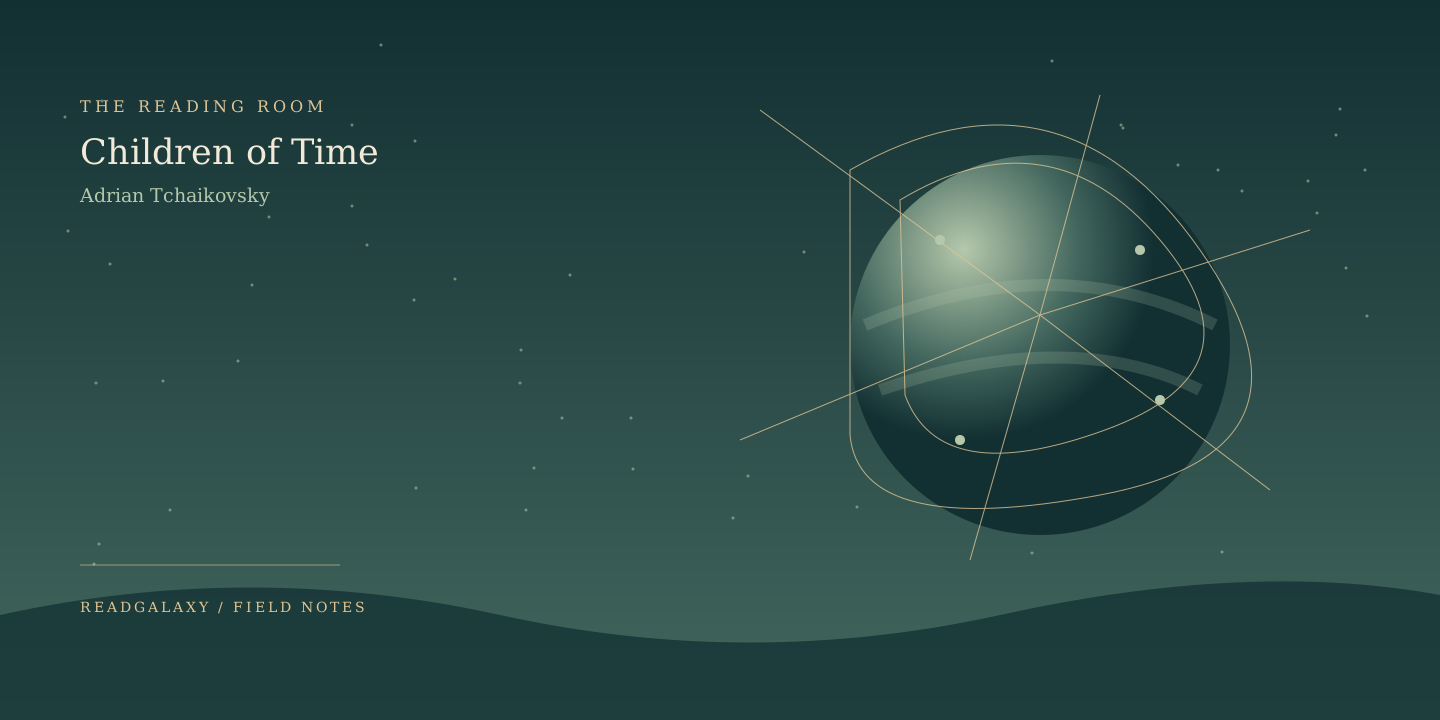
Children of Time reading order at a glance
- First book
- Children of Time establishes the project, the journey and the first encounter.
- Checked route
- Four novels through Children of Strife. Its October 2026 paperback date is not the novel’s first publication.
- Reading approach
- Follow publication order. These books develop their ideas through changing forms of intelligence, not a set of interchangeable adventures.
Where should I start?
Start with Children of Time, followed by Children of Ruin, Children of Memory and Children of Strife. The fourth novel first appeared in UK hardback in March 2026.
Go to the reading list ↓The title promises time, and the first novel makes good on that promise. A terraforming ambition and humanity’s search for somewhere to survive unfold alongside an unfamiliar history of intelligence. What looks like a practical problem from one perspective can be the foundation of an entire civilization from another.
That double vision is the reason to read the series in order. The books teach you ways of paying attention, then ask whether those habits are sufficient for the next encounter. Our guide keeps later plots behind the covers: it explains the route without turning the unusual minds into a list of surprises to expect.
Reference: Pan Macmillan: Tchaikovsky’s series guide ↗
One continuing conversation about intelligence
The novels connect through a shared setting and the consequences of exploration. These panels describe their emphasis rather than revealing the outcomes of individual encounters.
Open each chapter of the map to explore.
BEGINNINGTime and inheritance
Children of Time supplies the entry point. Human intentions shape a world, but intentions do not control every result. Watch the difference between what a technology was designed to do and what another species learns to do with it.
EXPANSIONRuin and memory
Children of Ruin and Children of Memory continue the sequence. Read them after Time even when a particular book seems to promise a fresh location. Their interest in communication and experience grows out of the assumptions earlier books have already asked you to reconsider.
CONTINUATIONChildren of Strife
The fourth novel belongs after Children of Memory. The publisher lists a UK hardback release of 26 March 2026, with a later paperback edition. Check the format when comparing dates: a forthcoming edition is not evidence that the story itself remains unpublished.
Reference: Adrian Tchaikovsky’s bibliography ↗
Choose your reading route
The published sequence through Children of Strife. Follow the titles rather than edition release dates.
-
Children of Ruin
Adrian TchaikovskyBook 2. Continue after Time.
Not yet in the library -
Children of Memory
Adrian TchaikovskyBook 3. Follow Ruin before opening this one.
View in the library ↗ -
Children of Strife
Adrian TchaikovskyBook 4. Published in UK hardback in March 2026; later editions have different dates.
Not yet in the library
Titles and scope: Pan Macmillan: Tchaikovsky’s series guide ↗
Read for the limits of your own assumptions
The pleasure here is often the moment when an apparently strange behaviour begins to make sense on its own terms. Resist translating every unfamiliar society into a disguised human one. Ask what a body, environment or lifespan makes easy, difficult or even possible to understand. The novels become richer when difference remains meaningful.
These are idea-heavy books, but they are also stories about vulnerability and dependence. You do not need a biology qualification to follow them. If an explanation feels dense, keep the immediate problem in view: who is trying to survive, communicate or make a decision, and what information do they actually have?
Explore Children of Time ↗A few reader questions
Is this still only a trilogy?
No. The checked route includes Children of Strife as a fourth novel. Older three-book guides describe an earlier state of the series.
Can I start with Children of Memory?
Our recommendation is Time, then Ruin, then Memory. A fresh premise does not remove the value of the earlier books’ context.
Does another Tchaikovsky series belong on this checklist?
No. Final Architects and his other series are separate reading projects. A shared author does not establish a shared fictional universe.