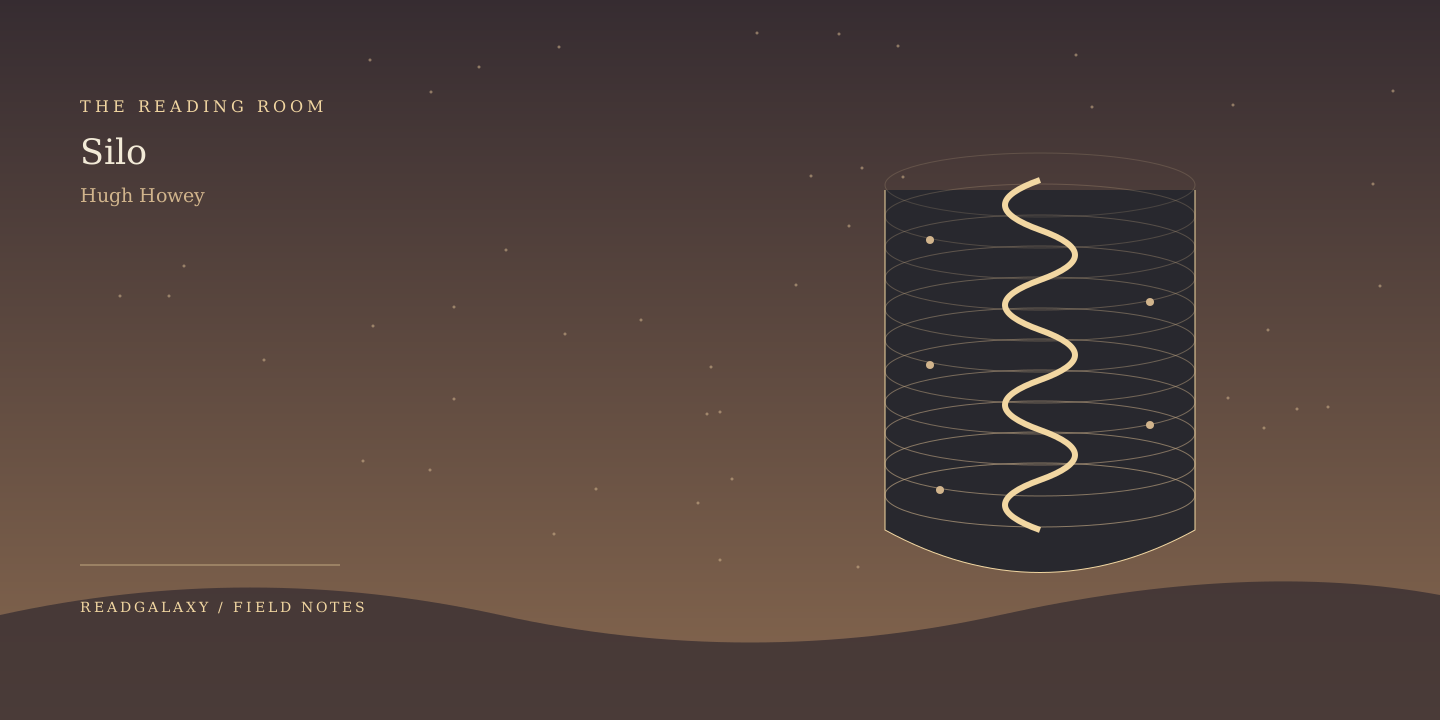
Silo reading order at a glance
- First book
- Wool. Begin inside the lived mystery rather than with the earlier-set Shift.
- Main route
- Three collected volumes: Wool, Shift and Dust.
- Edition trap
- Wool originally appeared in five parts; Shift also collects separately released parts. Those are not extra novels after the collected books.
Where should I start?
Read Wool, Shift and Dust in that order. Choose the collected Wool and Shift editions if you want this three-volume checklist to match your bookshelf.
Go to the reading list ↓The silo is a civilization built within limits its inhabitants cannot easily test. Work, routine and inherited rules make that environment feel ordinary to the people living there. The reader’s curiosity begins in the gap between what a society accepts and what one person is willing to question.
Hugh Howey’s publishing history can make this apparently simple trilogy look complicated. Wool began as shorter releases before being collected, and Shift has its own component parts. The three-volume route follows the collected books, so a list with more entries may describe the same material in smaller packages.
Three volumes, with history revealed in sequence
Publication and internal chronology do different jobs here. Our route introduces the mystery before the volume that looks further into the setting’s background.
Open each chapter of the map to explore.
WOOLMeet the world from inside
Start with the collected Wool. Its five original parts are a publishing structure within the first volume, not five sequels you need after reading the omnibus. Let the characters introduce the silo’s assumptions before seeking a complete outside explanation.
SHIFTThe history behind the conditions
Read Shift after Wool. Its earlier-set material is background you encounter after the opening mystery, not required preparation. Starting here changes what you already know about the world before Wool has a chance to introduce it.
DUSTContinue the trilogy
Dust follows the first two collected volumes. It is the third book in this route, not an alternative title for a final Wool installment. Television seasons and tie-in covers do not change its place in the prose sequence.
Reference: Hugh Howey: Dust ↗
Choose your reading route
Wool, then Shift, then Dust. Three collected books, without double-counting their original component parts.
-
Shift
Hugh HoweyCollected second volume. Read after Wool despite the earlier-set history.
View in the library ↗
Titles and scope: Hugh Howey: Silo series and collected editions ↗
The arrangement is part of the mystery
A first reading benefits from knowing no more than the opening characters can reasonably know. When a rule feels strange, ask how it is enforced and what makes it seem natural to the people obeying it. That lets the setting become a society, rather than a puzzle whose answer you need before entering.
If you arrive from the television adaptation, look for the collected title rather than a particular season’s cover. Adaptations expand, move or combine material. Use Wool as your book entrance and continue through the three-volume order. Before buying a bundle, compare its contents against any separate Wool or Shift parts you already own.
A few reader questions
Should Shift be first because it is a prequel?
Our recommendation is Wool first, then Shift. Earlier fictional events are not automatically a better entrance to a mystery.
Why do some stores show more than three books?
The original shorter releases can be listed separately. The route here counts the collected Wool, collected Shift and Dust.
Is watching the series required?
No. The novels introduce their own world. A television season is not a book number, even when its imagery appears on a new edition.