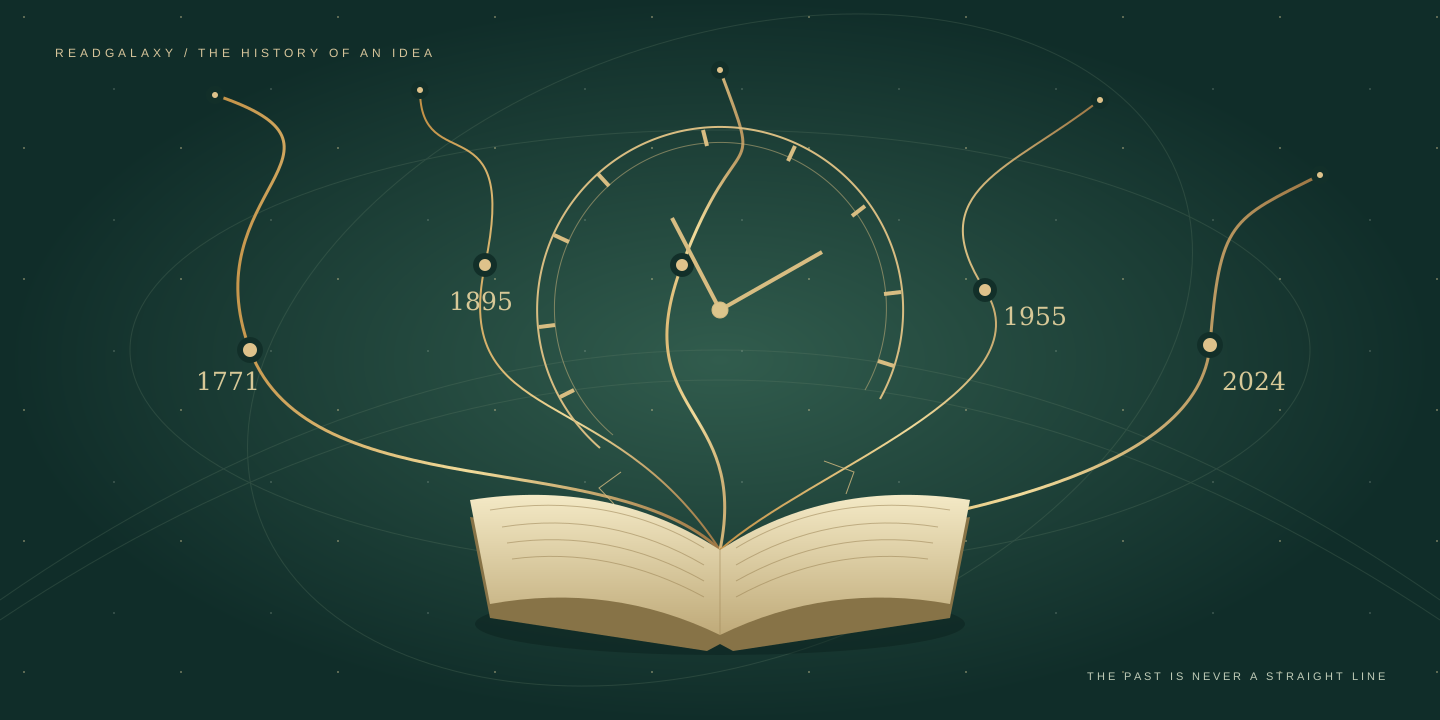
A map of the idea, at a glance
- The starting point
- Wells made the machine famous in 1895. Dreams, visions and even earlier machines came before him.
- What is in the tree?
- 25 selected works, dated by first publication. Novels, novellas and short stories are labelled separately.
- How to read it
- Branches group ideas, not proven lines of influence. Open a book to see what it contributes; use the year control to watch the map grow.
One idea. Five growing branches.
↓
2024
Open a title to discover its contribution. Follow a branch that interests you, or move through publication history. These connections mean “explores this question”, not “was directly influenced by.”
Getting outside the present
How do we reach another time?
1771The Year 2440
Utopian novel · precursorThe future becomes a place to visit.
A dream carries a visitor into a transformed Paris. The point is comparison: a future society makes the failings of the present easier to see. This is a precursor, not an engineered journey. The date refers to L’an 2440 in French; early English translations used different titles and even a different year in the title.
1843A Christmas Carol
Novella · supernatural visionsSeeing another time can change a life.
Scrooge is shown scenes from his past, present and possible future. The spirits provide a moral education, not a machine he can operate. It matters here because the emotional power of revisiting a life was established long before science fiction built complicated rules for doing it.
1881The Clock That Went Backward
Short storyAn object opens a route into history.
A strange clock connects its users to the past. This is an early mechanical-device story, although its atmosphere belongs to fantasy as much as engineering. Calling Wells the first person to imagine any time-travel device erases experiments like this one.
1887The Time Ship
Novel · Spanish originalA vehicle can carry people against time.
Originally El anacronópete, this Spanish adventure puts a group aboard an elaborate time-travelling vessel. It predates Wells’s novel by eight years. The English translation titled The Time Ship appeared in 2012; that translation date is not the birth date of the idea.
View in the library ↗1889A Connecticut Yankee in King Arthur’s Court
NovelModern knowledge collides with an older society.
Hank Morgan reaches Arthurian Britain without a controllable machine. The important experiment is social: does knowing more technology mean knowing how to build a better world? Twain makes the visitor’s confidence part of the problem, rather than a guarantee that history will improve.
1895The Time Machine
NovelTime becomes a navigable dimension.
A traveller operates a machine and explores the distant future. Wells joins a scientific-sounding mechanism to a disturbing question about humanity’s direction. Its importance is the durable model of deliberate temporal exploration, not an uncontested claim to have invented every kind of time-travel story.
View in the library ↗
Meeting your own consequences
What if you were already there?
1941By His Bootstraps
Short fiction · novellaA journey can help cause its own beginning.
Repeated encounters become harder to understand until the traveller’s personal sequence is separated from the order of events around him. The pleasure is reconstructing a causal circle. Read it without a plot diagram first: the explanation of who meets whom is much of the story.
1959“—All You Zombies—”
Short storyPersonal identity becomes a causal puzzle.
Heinlein compresses the loop into an exceptionally intricate problem of identity and origins. It is important to the history of paradox fiction, but its solution is a major spoiler. The title is not a promise of undead horror, and this entry is a story rather than a standalone novel.
1973The Man Who Folded Himself
NovelOther versions of you become a society.
A time belt lets its owner encounter versions of himself. Multiplication pushes the familiar meeting-your-double puzzle toward intimacy, identity and the limits of self-knowledge. This branch becomes psychologically complicated as well as mechanically complicated; it is an adult novel with sexual material.
View in the library ↗2007The Merchant and the Alchemist’s Gate
Short fiction · noveletteUnderstanding the past need not mean undoing it.
Nested tales around a time gate turn a consistent timeline into a story about regret and responsibility. Look for what a character can learn even when the rules do not promise a clean reset. First published in 2007, it was later collected in Exhalation in 2019.
Editing the world
Who gets to choose the future?
1952A Sound of Thunder
Short storyA small intervention can have a vast aftermath.
A commercial trip into prehistory makes interference a practical danger. This is a landmark fictional treatment of cascading consequences, not the invention of mathematical chaos theory. The central question is how little a visitor can disturb and still change too much.
View in the library ↗1955The End of Eternity
NovelChanging history becomes an institution.
Specialists work across centuries and make calculated changes to human history. Once editing is a profession, the question becomes political: who defines an acceptable future, and what opportunities disappear when risk is removed? Read it as a standalone novel; Foundation is not prerequisite homework.
View in the library ↗1995The Time Ships
Novel · sequel to WellsThe destination may change because you travelled.
Baxter returns directly to The Time Machine a century after its publication and expands the journey into alternative histories and a much larger cosmological canvas. This is a real sequel relationship, unlike the thematic connections elsewhere in this tree. Read Wells first; sequel descriptions can reveal his ending.
View in the library ↗201111/22/63
NovelA historical rescue has a human cost.
A portal into 1958 creates the possibility of preventing the Kennedy assassination. The mission demands years of living among people, not just a quick adjustment to a date. Its useful complication is the conflict between a historical objective and the life the traveller builds while pursuing it.
2019Recursion
NovelMemory and reality stop agreeing.
An investigation into memories of lives that apparently never happened grows into a temporal thriller. The reader must ask which experiences count as a personal past when the world’s history is unstable. This is a good later stop after becoming comfortable with rewritten timelines.
View in the library ↗
Being caught inside the past
What does a visitor owe the people there?
1969Slaughterhouse-Five
NovelA life cannot be contained by chronological order.
Billy Pilgrim’s movement through his life sits beside the novel’s account of war and Dresden. Read the temporal dislocation both as a speculative premise and as a form that invites questions about trauma and fatalism. Reducing it to a machine’s rulebook misses what the broken order does to the reader.
1976Woman on the Edge of Time
NovelA possible future becomes an argument about the present.
Connie Ramos’s contact with a future society challenges the power exercised over her in the present. The uncertainty of her position matters; this is not a neutral travel brochure for a guaranteed utopia. Compare its possibilities with the confident administrators of Asimov’s Eternity.
1979Kindred
NovelThe past has power over the visitor.
Dana is pulled from 1970s California into the slaveholding American South. Knowledge of another century does not make her safe. Ancestry becomes a source of obligation and danger, turning the abstract problem of preserving your existence into a confrontation with slavery and coercion.
1992Doomsday Book
NovelHistorical research becomes responsibility to people.
A historian’s journey into medieval England brings the distance between studying suffering and encountering it into focus. The book belongs to Willis’s Oxford time-travel setting, but works as an entry point. Choose it for historical immersion and emotional stakes, rather than a cheerful tour through the past.
View in the library ↗
Lives that refuse a straight line
What survives when time comes apart?
1987Replay
NovelA second chance can happen more than once.
A man dies and returns to his younger life with memories intact. Repetition lets the novel test what foreknowledge can buy and what it cannot settle. Bibliographic wrinkle: the first edition is dated 1986 but was published in January 1987; this tree uses the publication year.
2003The Time Traveler’s Wife
NovelTwo people experience one relationship in different orders.
Henry’s involuntary time travel gives him and Clare unequal knowledge of their shared life. The narrative asks the reader to track ages, meetings and absences, making chronology part of intimacy. This is not the first time-slip romance; it is a prominent modern exploration of the form.
2014The First Fifteen Lives of Harry August
NovelRepeated lives can carry knowledge across generations.
Harry repeatedly returns to childhood while retaining what he has learned. The premise expands beyond an individual do-over toward communication, responsibility and collective consequences. Compare it with Replay: the interesting difference is what repetition makes possible between people.
2019This Is How You Lose the Time War
NovellaA war across histories becomes a correspondence.
Two agents on opposite sides of a conflict exchange letters across time. Large-scale intervention and an intimate relationship occupy the same narrative. Follow the voices before trying to chart every strand: the structure invites attention to how messages change their readers.
View in the library ↗2022Sea of Tranquility
NovelA repeated anomaly joins distant lives.
An investigation connects experiences separated by centuries. The novel brings time travel into conversation with the nature of reality and the value of ordinary human encounters. Its compact shape is a useful reminder that a complex temporal structure need not require a very long book.
View in the library ↗2024The Ministry of Time
NovelPeople extracted from history must live somewhere.
A government programme relocates people from the past, assigning present-day staff to help them adapt. Time travel becomes an experience of migration, bureaucracy and unequal power, alongside romance and espionage. The difficulty is not only crossing centuries; it is deciding who controls the crossing.
View in the library ↗
No works on this branch by this year. Move the year forward or choose another branch.
Years are original publication years. The tree is a reading map, not a ranking or a complete genealogy. Some books belong to several branches; each appears once here.
Before the machine, there was the wish.
Imagine meeting yourself twenty years from now. The first question might be whether you are happy. The second might be whether anything you hear can change the answer. Between those two questions lies a surprisingly large part of time-travel fiction: the desire to know, followed by the fear of what knowing does.
The history of the form is not a neat sequence in which each new writer invents a more elaborate machine. Different traditions arrive at different doors. Some travellers want to inspect society. Others want to repair a mistake, escape a death, or recover a person. Still others discover that the trip they hoped would set them free has already helped produce the life they are trying to leave.
That is why this guide uses a tree. The branches are ways of asking questions, and the dates tell us when particular works entered the conversation. A line does not establish literary influence. Nor does a later date mean a better or harder book. Some of the tightest knots in the tree were tied before the middle of the twentieth century.
1771–1889: dreams, ghosts, clocks—and an overlooked ship
In Louis-Sébastien Mercier’s The Year 2440 (1771), a future Paris offers a position from which to judge the present. The journey is framed as a dream. The mechanism is less important than the change of viewpoint: what looks permanent in our own century might look absurd in another. This is one useful precursor, not the first temporal story in world literature.
Charles Dickens’s A Christmas Carol (1843) moves in a more intimate direction. Scrooge’s visions let one person experience his life as something larger than his immediate habits. A possible future becomes a reason to act now. We are not watching an engineer pilot a vehicle; we are watching knowledge of time become an ethical pressure.
Devices appear before Wells, too. Edward Page Mitchell’s short story “The Clock That Went Backward” appeared in 1881. Enrique Gaspar’s El anacronópete followed in 1887, giving its travellers a substantial vessel. Published in English much later as The Time Ship, Gaspar’s book is an especially good correction to the familiar claim that all time machines began in Victorian England.
Then Mark Twain’s A Connecticut Yankee in King Arthur’s Court (1889) makes the collision between eras a social experiment. A visitor’s modern knowledge is powerful, but power and wisdom are not interchangeable. Before time travel became a puzzle about causes, it was already a way to question the visitor’s certainty that his own age knew best.
Sources: Mercier’s original and translations; Dickens’s text; Mitchell’s bibliography; Gaspar’s publisher; Twain’s text.
1895: Wells gives the journey a working grammar
The Time Machine makes a remarkably portable imaginative proposal: treat time as a dimension through which a constructed device can move. Once a traveller can deliberately depart and return, the writer can make a journey through history behave like an expedition. The machine offers a reason to go, a way to come back, and a witness who can tell the tale.
But Wells is not simply demonstrating a clever vehicle. His far future turns assumptions about progress into questions. A society may become different without becoming better. Looking far enough ahead makes human arrangements seem temporary, and makes an apparently confident traveller confront how little his own explanations can guarantee.
The lasting shift is a reusable narrative tool. Later writers can change the destination, the rules, or who controls the journey. The machine is important because it opens those possibilities—not because every earlier dream, vision or device must be erased to make its inventor important.
Sources: the digitized 1895 edition; SFE’s account of the machine’s place in the genre.
1941–1973: the traveller becomes part of the mechanism
Exploration asks what exists at another date. A causal puzzle asks what happens when the visitor is part of the explanation for events there. Those are different pleasures. You can enjoy the strange destination in one book and spend the next drawing arrows between conversations in a notebook.
Robert A. Heinlein’s “By His Bootstraps” (1941) is a key stop. It rewards distinguishing the order of events from the order in which one person experiences them. “—All You Zombies—” (1959) tightens the connection between chronology and personal identity. Neither requires the reader to believe in time travel as physics; each asks for serious attention to the consequences of its fictional rules.
David Gerrold’s The Man Who Folded Himself (1973) lets encounters with other selves multiply. The puzzle becomes social and intimate: if other versions share your history but not all your experiences, what kind of relationship can you have with them? Counting versions is only the beginning of understanding the book.
Much later, Ted Chiang’s “The Merchant and the Alchemist’s Gate” (2007) demonstrates another use for constrained causality. A story can limit the possibility of undoing events while leaving room for insight, responsibility and compassion. Narrative complexity does not always mean adding another universe. Sometimes it means asking a better question inside a small, firmly bounded one.
Sources: The Heinlein Society; Heinlein’s bibliography; Gerrold’s novel; Chiang’s story in Exhalation.
You go back and leave a letter. Now what?
Three common models give three different answers. They are storytelling tools, not established instructions for real time travel. A book can also mix them or keep its answer uncertain.
The letter was always there.
Your trip is part of the history you came from. The discovery may change your understanding without changing what happened. The pressure falls on freedom, responsibility and circular explanation. A bootstrap loop is the special case where an object or piece of information circulates without an ordinary first origin.
The letter changes what comes next.
Events after the intervention can be replaced. The writer must decide who remembers the earlier history and what happens to the traveller who came from it. A dramatic change of outcome is not automatically a logical contradiction; it depends on the story’s own rules.
The letter opens another path.
The intervention leads to a different history while another history may continue. Preventing a catastrophe on one branch need not rescue the people on another. Watch how a story handles that moral distinction rather than assuming “parallel worlds” solves every problem.
When changing time becomes somebody’s job
Ray Bradbury’s “A Sound of Thunder” (1952) puts interference at the centre of a commercial expedition into prehistory. Its enduring lesson for fiction is scale: the significance of an action cannot be measured by how small it feels to the person doing it. The story is a literary landmark of cascading consequences; it should not be credited with inventing the scientific theory popularly associated with the “butterfly effect.”
In Isaac Asimov’s The End of Eternity (1955), history-changing acquires specialists and procedures. That changes the question again. A lone traveller might make a mistake; an institution can turn its definition of a better world into policy. Who chose the target? Who is allowed to object? What human possibilities disappear because someone has calculated that they are too dangerous?
Stephen Baxter’s The Time Ships (1995) offers a particularly clear example of an idea being revisited: it is a sequel to Wells’s novel, published a century later. The familiar journey opens onto alternative histories and a much larger temporal canvas. This is one connection we can identify as an actual continuation, rather than just drawing a line between works that happen to share a device.
Stephen King’s 11/22/63 (2011) brings the problem back to the length of a human life. Reaching a date before the Kennedy assassination means spending time there. The interval becomes a lived experience with relationships, obligations and competing desires. “Change one event” sounds tidy only while the years around that event are treated as empty space.
Sources: Bradbury’s publication history; Asimov’s publisher; Baxter’s bibliography; King’s official synopsis and date.
1969–1992: history stops being scenery
Another branch asks what a temporal journey does to someone who cannot stand safely outside events. In Slaughterhouse-Five (1969), Kurt Vonnegut’s dislocated chronology invites us to read time alongside war, memory and fatalism. The experience of reading a life out of order matters as much as any explanation of how Billy Pilgrim moves through it.
Marge Piercy’s Woman on the Edge of Time (1976) puts possible futures beside the present-day treatment of Connie Ramos. Whose vision is taken seriously, and whose is dismissed? The question of a future society cannot be separated from the authority to describe reality now. Its uncertainty is part of the novel, not a defect to tidy away in a diagram.
Octavia E. Butler’s Kindred (1979) is a decisive change of perspective in this selection. Dana’s movement into the slaveholding South does not give her the comfortable position of a tourist. Knowledge of the future offers no exemption from racial violence or coercion. The abstract question “what if I endangered my own ancestry?” becomes a problem of survival among people whose power over one another is brutally unequal.
Connie Willis’s Doomsday Book (1992) similarly narrows the distance between studying history and owing something to its people. A historian’s journey to medieval England becomes an encounter with individual lives. Put these works beside stories of competent engineers and time administrators: suddenly the visitor’s vulnerability is more interesting than the visitor’s superior equipment.
Sources: Vonnegut’s novel and editions; Piercy’s description; Butler’s official site; Willis’s publisher.
1987–2024: repeated lives, unequal memories, braided love
Ken Grimwood’s Replay (1987) gives a person another life with the benefit of remembering the first. Then repetition itself becomes the experiment. Foreknowledge might help with practical decisions, but does it settle what makes a life worth living? Claire North’s The First Fifteen Lives of Harry August (2014) takes repeated lives toward knowledge shared across people and generations. The stakes no longer fit inside one person’s second chance.
Audrey Niffenegger’s The Time Traveler’s Wife (2003) makes unequal temporal experience part of a relationship. Knowing someone is not the same as being known by them at that moment. Ages, absences and the sequence of meetings become emotionally consequential. This is a prominent modern time-slip romance, not the origin of romance across time.
Two very different 2019 books show how far the branches can spread. Blake Crouch’s Recursion makes memories of apparently impossible lives a gateway to unstable history. Amal El-Mohtar and Max Gladstone’s This Is How You Lose the Time War places a correspondence inside a conflict over possible futures. One asks us to follow reality coming under pressure; the other makes reading and answering another person a force within that pressure.
Emily St. John Mandel’s Sea of Tranquility (2022) connects distant lives through an anomaly and an investigation, bringing questions about reality into a compact human narrative. Kaliane Bradley’s The Ministry of Time (2024) asks what happens after historical people are brought into the present: who houses them, monitors them and decides what their new lives are for? The machine has become an administrative system, and displacement has become personal.
These books do not replace the earlier branches. A causal loop is still useful. So is a ghost, a portal, or a trip to a single unfamiliar century. What has expanded is the number of problems a story can connect to its temporal device. The deepest complication may not be how to get back. It may be whether returning can restore the relationship, society or self you thought you left behind.
Sources: Replay’s publication date; North’s publisher; Niffenegger’s account; Recursion; Time War; Mandel; Bradley.
Choose your reading route
Our compact route moves from exploration to a causal puzzle, historical responsibility, repeated lives and an intimate time war. These are independent works, not a series.
-
By His Bootstraps
Robert A. Heinlein1941 · Short fiction · novella. A journey can help cause its own beginning.
Not yet in the library -
Kindred
Octavia E. Butler1979 · Novel. The past has power over the visitor.
Not yet in the library -
Replay
Ken Grimwood1987 · Novel. A second chance can happen more than once.
Not yet in the library -
This Is How You Lose the Time War
Amal El-Mohtar & Max Gladstone2019 · Novella. A war across histories becomes a correspondence.
View in the library ↗ -
The Year 2440
Louis-Sébastien Mercier1771 · Utopian novel · precursor. The future becomes a place to visit.
Not yet in the library -
A Christmas Carol
Charles Dickens1843 · Novella · supernatural visions. Seeing another time can change a life.
Not yet in the library -
The Clock That Went Backward
Edward Page Mitchell1881 · Short story. An object opens a route into history.
Not yet in the library -
The Time Ship
Enrique Gaspar1887 · Novel · Spanish original. A vehicle can carry people against time.
View in the library ↗ -
A Connecticut Yankee in King Arthur’s Court
Mark Twain1889 · Novel. Modern knowledge collides with an older society.
Not yet in the library -
“—All You Zombies—”
Robert A. Heinlein1959 · Short story. Personal identity becomes a causal puzzle.
Not yet in the library -
The Man Who Folded Himself
David Gerrold1973 · Novel. Other versions of you become a society.
View in the library ↗ -
The Merchant and the Alchemist’s Gate
Ted Chiang2007 · Short fiction · novelette. Understanding the past need not mean undoing it.
Not yet in the library -
A Sound of Thunder
Ray Bradbury1952 · Short story. A small intervention can have a vast aftermath.
View in the library ↗ -
The End of Eternity
Isaac Asimov1955 · Novel. Changing history becomes an institution.
View in the library ↗ -
The Time Ships
Stephen Baxter1995 · Novel · sequel to Wells. The destination may change because you travelled.
View in the library ↗ -
11/22/63
Stephen King2011 · Novel. A historical rescue has a human cost.
Not yet in the library -
Slaughterhouse-Five
Kurt Vonnegut1969 · Novel. A life cannot be contained by chronological order.
Not yet in the library -
Woman on the Edge of Time
Marge Piercy1976 · Novel. A possible future becomes an argument about the present.
Not yet in the library -
Doomsday Book
Connie Willis1992 · Novel. Historical research becomes responsibility to people.
View in the library ↗ -
The Time Traveler’s Wife
Audrey Niffenegger2003 · Novel. Two people experience one relationship in different orders.
Not yet in the library -
The First Fifteen Lives of Harry August
Claire North2014 · Novel. Repeated lives can carry knowledge across generations.
Not yet in the library -
Sea of Tranquility
Emily St. John Mandel2022 · Novel. A repeated anomaly joins distant lives.
View in the library ↗ -
The Ministry of Time
Kaliane Bradley2024 · Novel. People extracted from history must live somewhere.
View in the library ↗

Historical overview; individual book sources are linked in the tree above ↗
Read for the rule—and then for what the rule costs
When you open one of these books, try keeping two small maps. One follows the order in which events happen in the world. The other follows the order in which the protagonist experiences them. A puzzle that seems impossible often becomes legible when those maps stop pretending to be the same thing.
Then add a third question: whose experience has the diagram left out? The person waiting at home, the people whose century becomes an experiment, or the version of someone whose future has been discarded? This is where a clever mechanism can become a powerful novel.
You do not need to read this list from beginning to end. Choose the question that bothers you most. Can a future be prevented? Can an unchangeable past be understood differently? Can two people share a life without sharing its order? The best next book is the one that makes that question harder to stop thinking about.
A few reader questions
Did H. G. Wells invent time travel?
No single answer survives every definition of time travel. Earlier literature used dreams, supernatural visions and time slips; Mitchell’s 1881 story used a clock, and Gaspar’s 1887 Spanish novel used a vehicle. Wells’s 1895 novel made deliberate travel through a time dimension an enduring model.
Are the lines in the tree claims that one author copied another?
No. They connect works to a shared narrative question. Dates show when works appeared, not proof that their authors read one another. The explicitly identified exception is Baxter’s The Time Ships, a sequel to Wells’s The Time Machine.
Does a flashback count as time travel?
Not by itself. A flashback changes the order in which a reader receives information. Time-travel fiction usually changes a character’s relation to time inside the story. Some works deliberately blur those categories, so the tree labels visions and precursors instead of pretending that every example uses a machine.
Why include short stories in a guide to books?
Some influential temporal experiments were published as short fiction. By His Bootstraps, A Sound of Thunder and “—All You Zombies—” should not be silently presented as full-length novels. Their dates here refer to the original stories, not later collections.
Is a newer time-travel novel necessarily more complex?
No. A 1941 causal puzzle may require more diagramming than a recent novel. What expands over time is the range of questions authors combine: mechanisms, history, identity, memory, politics and relationships. Complexity is not a ranking of literary quality.